
Clay County Court Records After Arrest
A Clay County arrest can produce more than one record. The first record is the jail booking or holding record at Clay County Jail. The later public case record appears when prosecutors file charges in Iowa district court. Those two records may not match word for word. A booking entry can list an arrest charge, warrant, hold, or temporary reason for confinement, while the court record reflects the charge selected, amended, dismissed, or resolved through the case.
The practical pathway is arrest, booking, initial appearance, prosecutor review, filed charging document, court docket, bond or release order, hearings, plea or trial, and disposition. For current custody and booking status, use Clay County jail inmate records. For booking photos, use Clay County jail mugshots. For the charge record after a jail arrest, Iowa Courts Online and the Clay County Clerk are the main public routes.
Find Clay County Court Records
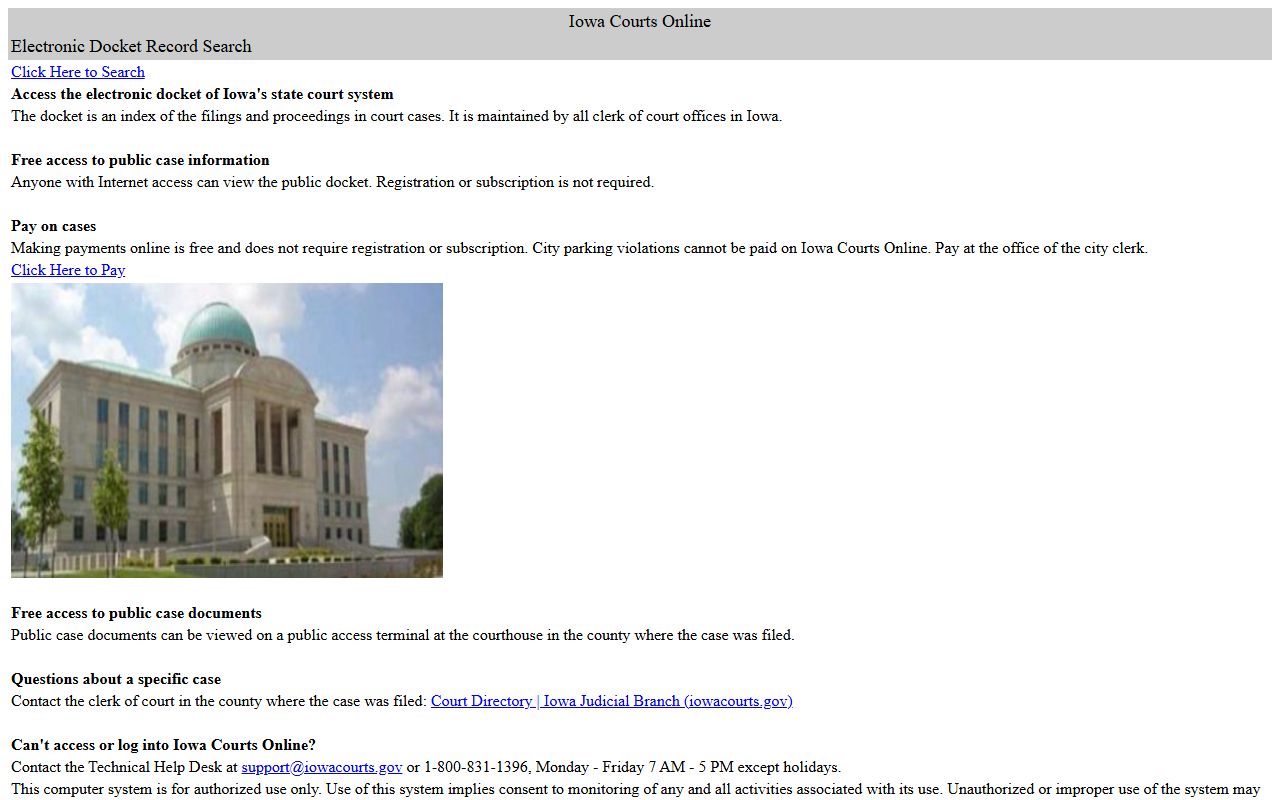
Iowa Courts Online is the statewide public docket search for Iowa trial court and appellate court information. The Clay County Attorney page also links readers to free statewide court information through Iowa Courts. Public docket information can include case titles, parties, lawyers, criminal charges, dispositions, fines, fees, payments, and filed events, but the Iowa Courts help material warns that online docket information is not the official court record.
The matched Iowa Courts Online screenshot below shows the public search entry point used for Clay County court records after a jail arrest.
If a public docket entry is missing, old, confidential, or not yet indexed, the fallback is the Clay County Clerk at (712) 262-4335. Citation records may take time to appear, and older trial court cases may require clerk or courthouse access.
| Search Mode | Field | Required | Notes |
|---|---|---|---|
| Trial court name | Last or firm name | Yes | Official help states at least two letters are required. |
| Trial court name | First name | No | Narrows a person search. |
| DOB search | Date of birth, first name, last name | Yes | Exact date of birth is used with both names. |
| Case ID | County | Yes | Select Clay when the case is filed in Clay County. |
| Case ID | Case type | Yes | Choose the applicable case type shown by the portal. |
| Case ID | Case ID | No | Official help references an optional 17-character case ID. |
| Citation | Citation number | Yes | Citations may take up to 14 days to appear. |
| Appellate | Docket number, case title, party, lawyer, or role | Varies | Use when the case has moved to appellate court. |
Clay County Attorney Charges
The Clay County Attorney is Travis S. Johnson. Iowa counties use the title County Attorney, not District Attorney. The office prosecutes violations of Iowa state criminal law and county ordinances, represents the state and county in official cases, and handles other public duties listed on the county site. That prosecutor role matters because a jail arrest alone is not the final court charge record.
The County Attorney page also lists limits. The office does not give private legal advice, defend private persons, prepare private legal documents, or file private lawsuits for residents. Questions about a defendant's own legal rights should go to a lawyer. Questions about public docket entries should usually go to Iowa Courts Online or the Clay County Clerk, not to the prosecutor as a substitute for court records.
The matched Clay County Attorney source page shows the office contact and duties that support the charging-role description.
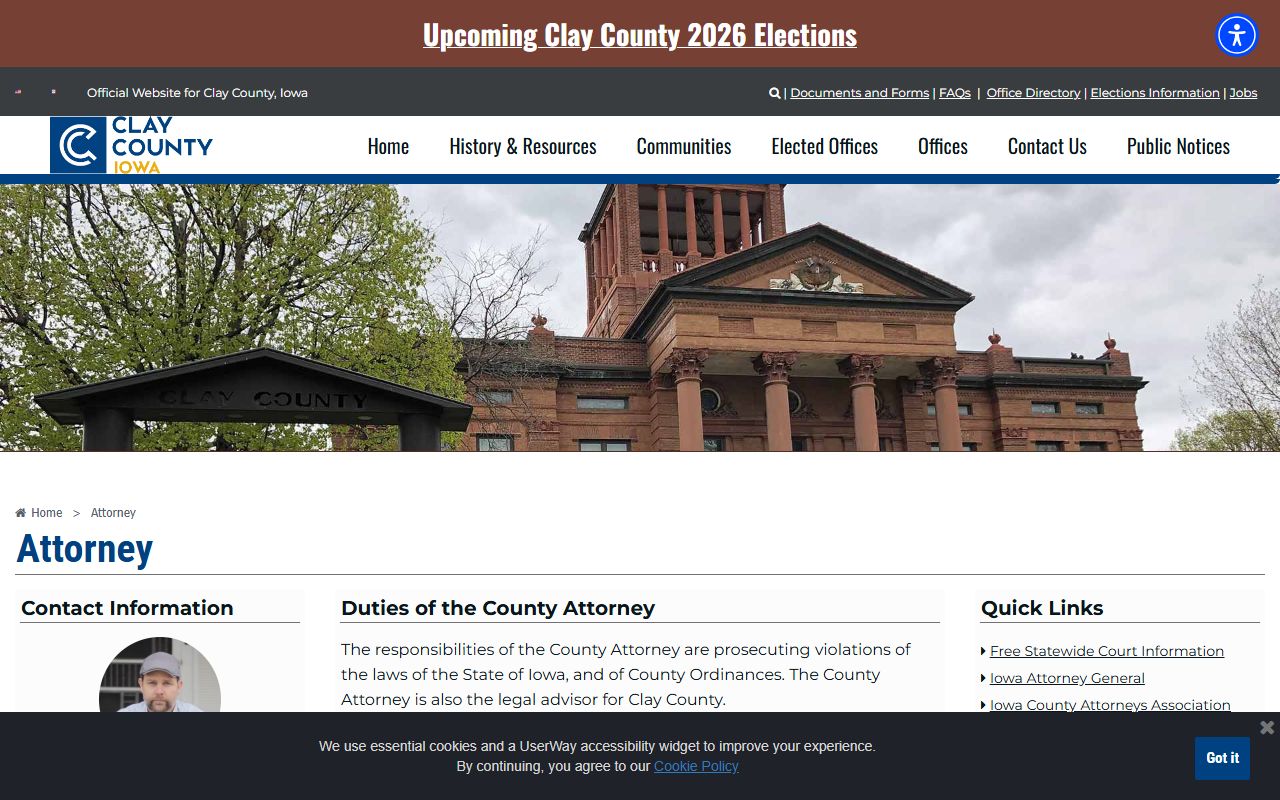
The attorney office is a charging authority, not a public defender, private lawyer, or general case-advice service.
Clay County Charging Documents
Court records after a Clay County jail arrest become easier to read when the charging document is identified. Iowa criminal cases may involve a complaint, trial information, or indictment. A complaint often begins a case. A trial information, sometimes called an information, is a prosecutor-filed charging document used in Iowa felony procedure. An indictment is a grand-jury accusation and is less common in routine local cases.
| Document | Who Files It | What It Does | Clay County Search Note |
|---|---|---|---|
| Complaint | Officer or prosecutor | States the alleged offense and can start the criminal case. | May appear close to booking or initial appearance. |
| Trial information | County Attorney | Sets out prosecutor-filed formal charges, often in felony procedure. | Compare it with jail booking charges because it may differ. |
| Indictment | Grand jury | Formal accusation by a grand jury. | Less common than prosecutor-filed information for routine cases. |
Clay County Charge Status
Charge status can change after arrest. A charge can be pending at first, amended after review, reduced through plea negotiations, dismissed by the court, or resolved by plea, verdict, deferred judgment, or sentence. That is why a Clay County court records search after an arrest should check each count, not just the first charge listed in a jail or docket summary.
| Status | Meaning | Record Caution |
|---|---|---|
| Pending | The charge is active and unresolved. | It is an accusation, not a conviction. |
| Amended | The prosecutor changed or replaced the charge. | Earlier docket text may remain visible. |
| Reduced | The charge was lowered to a lesser offense. | Check the final disposition, not only the original count. |
| Dismissed | The count ended without conviction on that charge. | Dismissal may not erase every public record automatically. |
| Deferred judgment | Judgment may be deferred under court conditions. | Later expungement eligibility depends on the law and case facts. |
| Conviction | A formal judgment of guilt or plea/adjudication. | Different from arrest or charge filing. |
Bond After Clay County Arrest
Bond and release are court-controlled. Clay County jail staff can report what is shown in the jail record, but only a court can set or change bond conditions. Iowa Code chapters 804 and 811 supply the statewide framework for arrest, initial appearance, release, and bail. Clay County's official jail pages do not publish a local bond-payment schedule, accepted payment methods, or after-hours cashier procedure, so those details must be verified before payment.
- Confirm the person is actually held at Clay County Jail by calling (712) 264-4242.
- Ask whether a judge has set bond and whether any no-bond order, warrant, detainer, or hold blocks release.
- Ask whether payment must be made at the jail, clerk of court, or another court or custodian.
- Keep the receipt and case information, then verify release timing because paperwork, transport, no-contact orders, or another agency can delay release.
| Release Type | How It Works |
|---|---|
| Cash bond | Money is posted to secure appearance, subject to court and payment rules. |
| Surety bond | A surety or bail agent may post bond when allowed by Iowa and local practice. |
| Personal recognizance | Release is based on a promise to appear and follow conditions. |
| Conditional release | Release may include no-contact, supervision, travel, treatment, or other court conditions. |
| No-bond hold | The person cannot be released until a court or holding agency changes the hold. |
Clay County Warrants and Holds
No official Clay County active-warrant search or warrant list was located on the county or sheriff pages reviewed. If a warrant led to the jail arrest, the safest public route is to verify through the issuing court, the Clay County Clerk, the sheriff's office, or counsel. Do not assume a third-party warrant database is complete or current.
A warrant can come from a new arrest warrant, a bench warrant for failure to appear, a probation or parole violation, another county, a federal authority, or a fugitive hold. The jail booking may show a hold reason, while the underlying court case may sit in another county or court. A person can remain in custody even after local bond is posted if another agency has a detainer.
The matched Clay County important phone numbers page lists the sheriff, jail, county attorney, clerk, and Spencer Police contact routes used for warrant and court-record fallback.
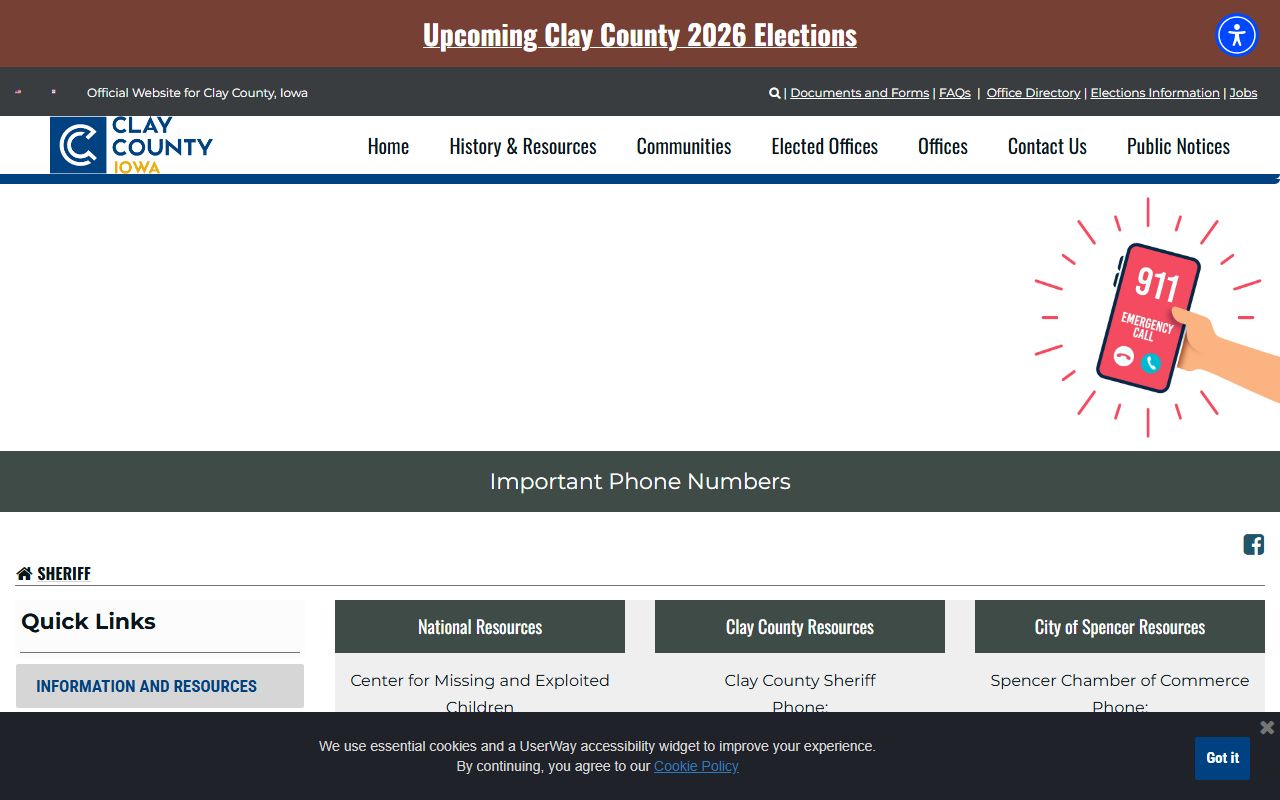
Those phone numbers are especially useful when Iowa Courts Online does not yet show a docket event or when the warrant comes from a different agency.
Charge vs Conviction
A Clay County court record after arrest can show both accusations and outcomes. Treat a charge as a filed allegation until the court record shows a plea, verdict, judgment, or dismissal. This distinction matters for employment, housing, licensing, and news reading, but consumer-reporting uses must follow FCRA rules through proper channels.
| Point | Charge | Conviction |
|---|---|---|
| Stage | Accusation filed in court. | Final guilt finding or plea accepted by the court. |
| Proof | Based on charging standards and probable cause. | Requires plea, verdict, or judgment under criminal procedure. |
| Record meaning | May be pending, amended, reduced, or dismissed. | May support sentencing, fines, probation, jail, or prison. |
| Search caution | Do not treat it as guilt. | Check for appeal, deferred judgment, or later expungement. |
Sealed vs Expunged Records
Iowa Chapter 901C covers expungement for eligible criminal records, but expungement is a court process rather than an automatic result of dismissal, acquittal, deferred judgment, or release from jail. Iowa Courts Online and clerk access can also be limited for juvenile, confidential, sealed, or otherwise restricted cases. Public docket limits do not mean no case ever existed. They mean the public portal may not show it.
| Point | Sealed or Restricted | Expunged |
|---|---|---|
| Public view | Hidden or limited from public access by rule or order. | Removed from public access when a court grants eligible relief. |
| How it happens | Confidential case type, statute, or court order. | Petition or statutory process under Iowa law. |
| Law enforcement view | May still be available to authorized agencies. | Access depends on the statute and record type. |
| Clay County action | Ask the clerk what public access is allowed. | Use the court process and follow the order's scope. |
Chapter 22 Record Limits
Iowa Chapter 22 gives the public the right to examine and copy public records unless another law makes the material confidential. It also allows requests in person, in writing, by telephone, or electronically and permits custodians to charge reasonable or actual costs. For Clay County court records after a jail arrest, Chapter 22 is most useful for sheriff or jail records that are not posted online, not for replacing the court docket or clerk's official file process.
The matched Iowa Public Information Board Chapter 22 page explains the open-records request channels and exceptions.
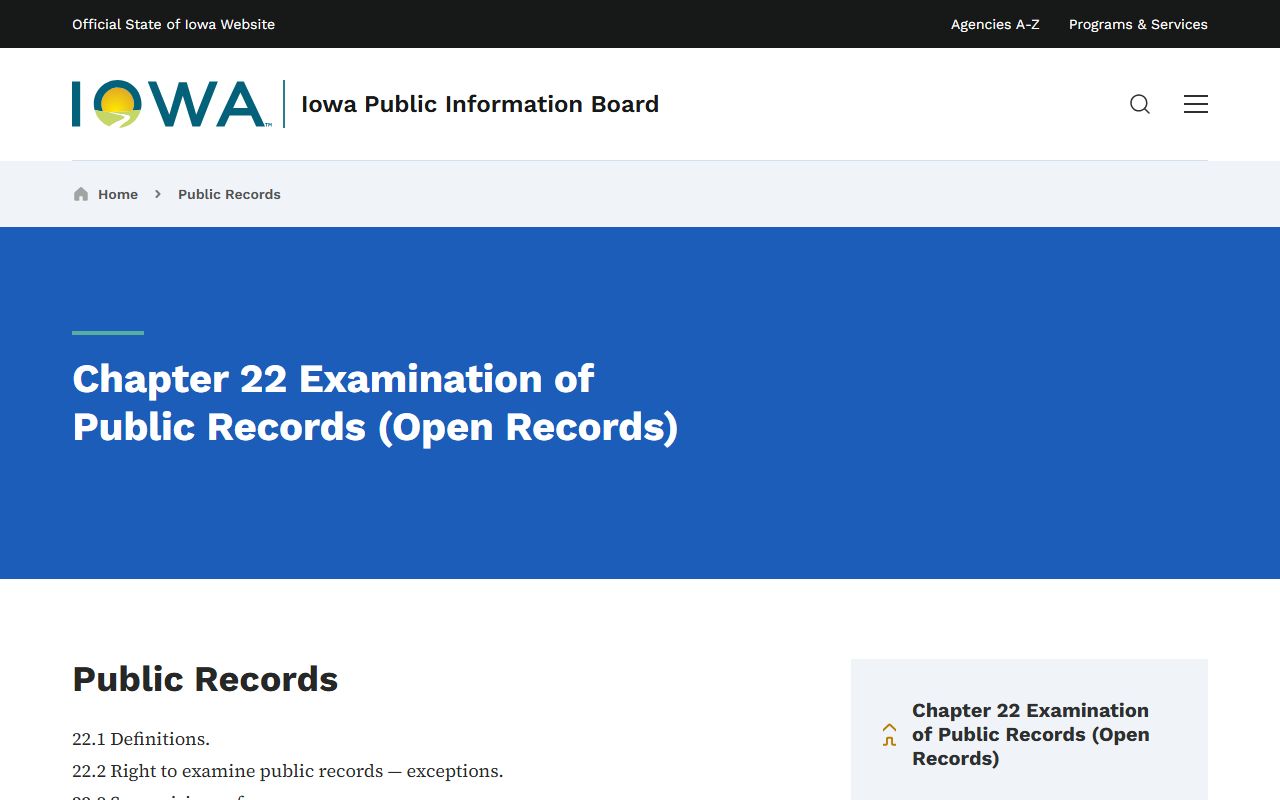
Chapter 22 does not open juvenile records, medical records, confidential investigative reports, victim information, or safety-sensitive law-enforcement details when another law protects them.
Important: Use official court, jail, clerk, and prosecutor records for verification. Public summaries can be incomplete, delayed, sealed, or later changed by court order.